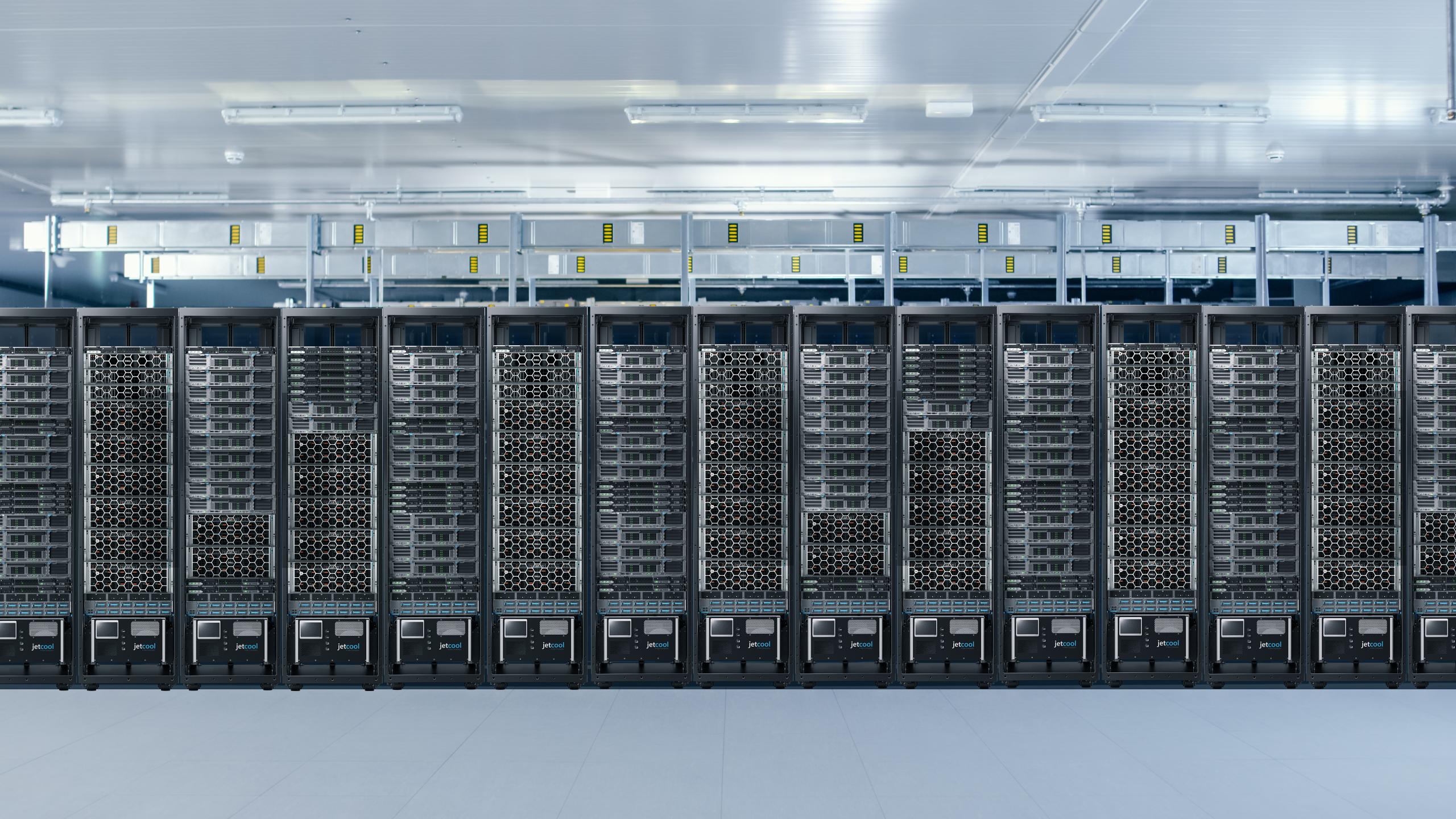
High-frequency trading infrastructure has developed around one priority: achieving the fastest and most consistent access to markets. Accomplishing that begins with placing systems physically close to exchanges, brokers, clearing firms, and counterparties, then connecting them through high-speed network links that are extremely reliable and deliver consistent data transfer performance. Sites must also meet stringent regulatory and data governance requirements. These demanding conditions have led firms to implement distributed footprints across both internal data centers and colocation sites, with the vast majority using air cooling to provide thermal stability.
The growing use of AI for market analysis, fraud detection, risk modeling, and inference is fundamentally changing infrastructure requirements within trading environments. These workloads demand significantly more compute density than traditional trading applications, pushing many facilities toward their thermal and power limits.
However, each new generation of CPU and GPU uses more electricity and produces more heat than the previous one. AFCOM’s 2026 State of the Data Center report highlights this upward trend, and the impact it’s having at the rack level, finding that average rack density climbed from 16 kW to 27 kW over the past year – a 69% increase. Progressively more demanding AI workloads will continue to drive the need for more compute, more memory, and higher rack-level density. As this happens, many trading facilities are hitting their thermal ceilings.
Sticking with a rack-level perspective, as a general guideline, ASHRAE TC 9.9 puts the air-cooling “sweet spot” in the 20 to 30 kW-per-rack range, with optimized designs able to extend the zone to roughly 40 to 50 kW. Beyond there, air cooling becomes both economically and technically impractical, and liquid cooling is clearly the way forward.
HFT Infrastructure Challenges:
- AI workloads are driving increased rack densities.
- Many air-cooled facilities are reaching their thermal limits.
- Downtime and trading disruptions are unacceptable.
- Latency and regulatory requirements constrain where capacity can be added.
- Most environments are still optimized for air cooling.
- Limited space availability makes expansion or relocation difficult.
However, for trading firms, wholesale implementation of liquid cooling in their existing sites, or relocation to new, liquid-cooled facilities, are rarely feasible. The question is how to capture the thermal performance and power savings of liquid cooling within the sites they already depend on.
This blog explores how liquid-assisted air cooling (LAAC) gives trading firms a practical way to incrementally increase compute density without disrupting critical infrastructure.
Deterministic Performance: A Critical Thermal Challenge
When looking at the density and cooling challenge, it’s important to first understand that trading system performance is defined not only by speed but by how well it operates during peak loads. Deterministic performance means delivering predictable response times when markets are most demanding: at the open, during volatility spikes, across high-volume windows, and during brief surges in market data traffic. Those are also the moments when thermal spikes are most likely to affect performance. As RapidAddition CTO Deepak Dhayatket noted during the 2026 TradingTech Summit in London, trading workloads arrive in short, intense bursts as order flow, quote updates, market data feeds, and inference requests spike. When processors approach thermal limits, clock speeds can fluctuate and throttling can occur, making latency less consistent. That can be critical, as even small latency variations can create execution jitter, missed opportunities, and increased financial risk.
In highly optimized trading environments, nanoseconds of variability can matter more than peak benchmark speed. The most important failures often appear in tail-latency events, where systems behave differently under the most demanding conditions. In the widely cited Communications of the ACM article “The Tail at Scale,” Google researchers Jeffrey Dean and Luiz André Barroso show that even rare high-latency episodes can dominate system performance as scale and utilization increase. A platform may look strong on average and still produce outlier latency during traffic surges, thermal saturation, or rapid workload transitions. The objective is not simply to run faster; it is to run consistently when conditions are least predictable.
Processor cooling, therefore, becomes a direct factor in execution quality, risk control, and profitability. Direct-to-chip (DTC) liquid cooling meets these thermal constraints by moving heat away from CPUs, GPUs, and accelerators more efficiently than air. This helps maintain stable thermal ranges under sustained load and during sharp workload spikes, supporting more predictable latency, reducing the risk of throttling, and allowing more of the available power budget to be used for compute instead of fan-driven cooling.
The challenge is how to achieve the chip-level benefits of liquid cooling without implementing facility-level plumbing.
Liquid-Assisted Air Cooling: A Practical Solution for Air-Cooled Facilities
Server-level liquid-assisted air cooling (LAAC) gives firms a low-friction way to add DTC cooling inside existing air-cooled facilities. Instead of moving liquid through the rack or facility, LAAC keeps the liquid loop contained within the server. Heat sinks are replaced with cold plates that capture heat directly from the processors, and a sealed internal loop carries that heat to an integrated liquid-to-air radiator, where it is rejected back into the data hall. The result is DTC liquid heat removal performance in a system that still operates within the air-cooled infrastructure firms already use.

Less power and noise: By removing processor heat more efficiently, LAAC allows server fans to run at lower speeds. That reduces average server power consumption, preserving more of the site electricity budget for compute and helping firms add density. Lower fan speeds also reduces server noise, improving operating conditions.
Simpler deployment: Because LAAC is implemented at the server level, firms can deploy it incrementally as part of normal refresh cycles, pilots, or targeted upgrades. That makes it possible to add thermal headroom and increase compute density without broad changes that could disrupt production environments.
Faster payback: LAAC starts delivering value as soon as each equipped server is installed. That makes LAAC a lower-risk bridge to higher-density infrastructure.
One example of this approach is JetCool’s SmartPlate System for Dell 17th generation servers. Testing has shown average server power reductions of 13%, fan speed reductions of up to 50%, and server noise reduction of up to 60%. Its rugged, all-metal construction and hinged radiator also support serviceability, including easier DIMM access These improvements allow organizations to reclaim power budget, improve thermal stability, and support higher compute density within existing infrastructure. .
For many trading environments, liquid-assisted air cooling provides a practical way to extend existing air-cooled infrastructure and support higher compute density.
Conclusion
For trading firms, the infrastructure challenge is no longer just about adding compute. It is about increasing density, supporting AI-driven workloads, and preserving deterministic performance without abandoning the sites, proximity advantages, and operational controls their strategies depend on. Liquid-assisted air cooling offers a practical bridge. By bringing direct-to-chip heat removal into servers that can still operate in air-cooled facilities, LAAC provides a way to unlock more compute and maximize thermal headroom while firms design their next-generation data center infrastructure.
That bridge matters because the transition to liquid-cooled infrastructure will not happen through single facility-wide conversions. It will happen in phases, as firms extend existing environments, prove new cooling models, and decide where full liquid-cooled designs make sense. During that transition, LAAC can be a core part of how trading firms incrementally adopt liquid cooling and support AI growth without disrupting the infrastructure they already depend on.