Everyone in the data center space has experienced it: the dreaded call — “we’re down.” Even before today’s AI boom, data center outages ranked among the most damaging forms of downtime. Why? Because every minute offline pushes profitability further out of reach.
According to Uptime Institute’s Annual Outages Analysis 2025 report, 54% of respondents said their most severe data center outage cost $100,000 or more, and 20% reported costs exceeding $1 million. In 2025, half of data center operators reported at least one impactful outage in the past three years.
And the financial hit isn’t the only concern. Large, public-facing outages generate immediate media attention. For industries like finance, healthcare, cloud, or colocation, no one wants to see their brand leading the latest outage headline. Once the news breaks, SLA penalties, customer reimbursements, and regulatory scrutiny quickly follow.
As digital services become more integrated into daily life, tolerance for downtime keeps shrinking. Uptime guarantees get tighter. Penalties get harsher. Data Center Dynamics notes that a sample colocation SLA may impose:
- 15% of Monthly Base Rent (MBR) for delayed incident notification
- 25–200% of MBR for uptime below 99.999%
- Up to 500% of MBR per month for critical connection outages
For high-risk sectors, downtime can exceed $5 million per hour — and that’s before fines or reputational damage.
Suffice it to say: downtime is one of the most costly and dreaded events a CEO can face. With industry estimates hovering around $9,000 per minute, investing in resilient, modern infrastructure is not optional.
What Are the Main Points of Failure?
According to the Uptime Institute Global Data Center Survey 2025, the top contributors to impactful outages are:
- Power (45%)
- Cooling (14%)
- Network (11%)
Power: Power remains the leading cause of data center outages, accounting for 45% of impactful incidents, with UPS failures, transfer switch issues, and generator failures driving most of these events. These issues often trace back to legacy infrastructure, limited redundancy, and inconsistent maintenance — conditions that leave facilities more vulnerable when the utility feed wavers.
AI workloads heighten this risk by introducing highly variable, fast‑changing power demands that strain both the grid and on‑site electrical systems. Research suggests that these rapid power swings create additional stress on aging infrastructure, increasing the likelihood of the same failures that already dominate outage root‑cause patterns.
Cooling: AI-dense servers run hotter and under more consistent load than traditional architectures. Legacy air cooling systems struggle to keep up, and when they fall behind, throttling, thermal runaway, and emergency shutdowns can cascade quickly.
Network & IT Hardware: Network issues and hardware failures remain notable contributors but often originate from upstream power or cooling disturbances — further reinforcing where the real risk lies.
Vertically Integrated Racks: Reducing Downtime Risk through Unified Design
The need for tighter coordination between power and cooling is increasingly recognized across the data‑center industry. This aligns with broader trends identified by McKinsey & Company, which emphasize that integrated horizontal and vertical reference designs — spanning electrical, mechanical, and structural systems — allow developers to standardize 60–80% of infrastructure while reducing complexity and supply‑chain risk. While McKinsey’s recommendations focus on facility‑level architecture, the same principle applies at the rack level, where power delivery and thermal management ultimately converge.
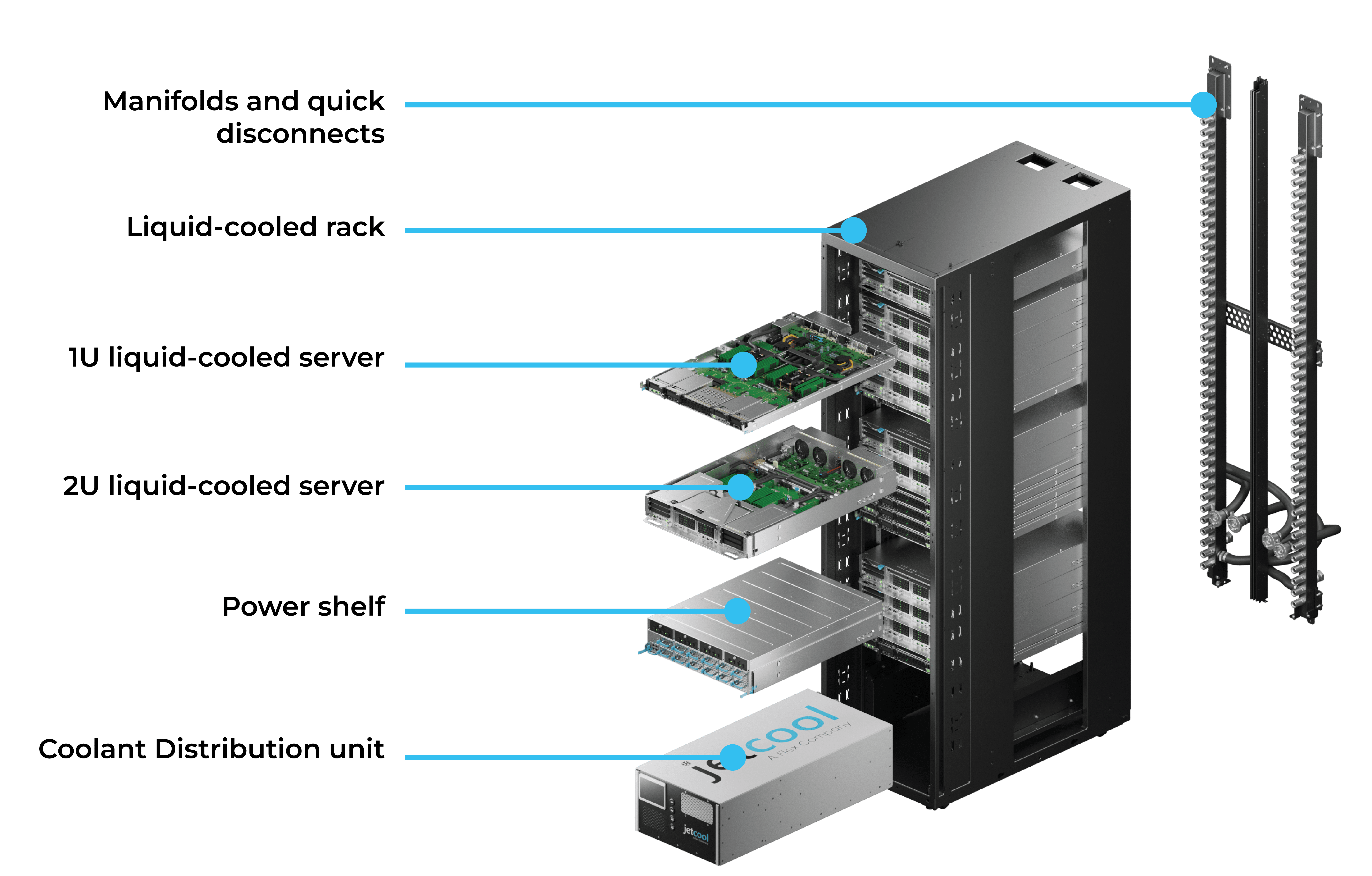
Vertically integrated liquid‑cooled racks extend this principle downstream. By engineering power distribution, coolant flow, sensing, and control as a single subsystem rather than a set of independent parts, they create a more predictable and resilient thermal‑power envelope. This rack‑level integration reduces failure modes, simplifies deployment, and enables the entire data center to operate more consistently and efficiently — more like a finely tuned instrument than a loose collection of components.
Power Quality: Critical to Reducing Downtime
Recognizing these risks is only the first step. The next is partnering with experts who can guide you through creating a complete solution — from power and cooling to infrastructure and software. Power quality is a system-level challenge that requires system-level solutions. Without a holistic approach, even high-quality power can’t prevent downtime if cooling, rack design, or IT workloads are misaligned.
Flex works closely with leading chip manufacturers and top data center operators to anticipate power challenges and align solutions with evolving product roadmaps and high-density AI architectures. Their portfolio of critical and embedded power products, combined with direct-to-chip liquid cooling, provides visibility from grid to chip, enabling predictive, end-to-end resiliency planning.
The Flex Capacitive Energy Storage System (CESS) strengthens this architecture further by balancing spikes during large electrical transients, absorbing and supplying energy as power fluctuates. By modulating short‑term power swings directly within GPU racks, CESS stabilizes the electrical environment, protects aging infrastructure, and reduces stress on the grid — improving uptime and mitigating transfer events under fast‑changing, high‑density AI workloads.
When integrated into a complete rack solution, customers receive a dynamic, future‑proofed system with a coordinated grid‑to‑chip power ecosystem, reducing the likelihood and impact of outages across their data center.
Resilient Liquid Cooling Reduces Power Needs — and Downtime Risk
This is why analysts at McKinsey & Company note that next‑generation data centers must integrate advanced cooling technologies alongside modern electrical architectures to support high‑density, resilient computing. In other words, power reliability and cooling efficiency can’t be solved independently; they must be co‑engineered and designed for from the start.
A resilient cooling strategy stabilizes power draw, protects uptime, and reduces operational strain, yielding direct operational and financial benefits. With technologies like JetCool microconvective cooling® customers can:
- Realize up to 18% power savings
- Reduce water consumption by up to 90%, and eliminate the need for evaporative cooling in most climates
- Achieve an average of 15% total server power savings with liquid-assisted air-cooled (LAAC) deployments
These improvements don’t just enhance sustainability — they reduce strain on power systems, decreasing the likelihood of outages caused by overload conditions or cooling deficiencies.
Minimizing Downtime Through Integrated Power and Cooling
Modern resiliency isn’t just about redundancy — it’s about designing systems that actively reduce risk at the source. Together, Flex companies are helping data centers stay online, stay efficient, and stay ready for the future.