
As data centers proliferate to support digital growth, their cooling requirements have spurred increasing concerns about water consumption and sustainability. In The Future of Water Resilience in the U.S., J.P. Morgan and ERM Sustainability Institute address the critical role water plays in data center cooling and call for a shift towards sustainable practices. Uptime Institute’s recent report, Cooling Systems: Balancing Cost, Energy, and Water Use, highlights how water scarcity, regulatory pressure, and environmental impacts are reshaping cooling strategies in the industry. Together, these reports paint a picture of an evolving ecosystem that must balance water resilience, operational efficiency, and environmental stewardship. At JetCool, our single-phase direct liquid cooling technology aligns with these evolving demands by providing a solution that raises system operating temperatures to increase the utilization of free cooling. It also increases the temperature differential across the external heat transfer system to increase chiller plant efficiency. This approach reduces both energy and water consumption, increases cooling system efficiency, and lowers data center PUE.
The Current Water Landscape in Data Center Cooling: Challenges and Constraints
Both J.P. Morgan and ERM Sustainability Institute and Uptime’s reports underscore how water-based air cooling systems have enabled efficient operations in the past. Yet, the drawbacks are becoming more pronounced: water-cooled air systems often consume millions of gallons per year, straining local water supplies, especially in water-scarce regions.
On average, a mid-sized data center consumes roughly 300,000 gallons of water per day. Large data centers can use between 1 to 5 million gallons per day—equivalent to the daily water consumption of a town of 10,000 to 50,000 people. While hyperscalers will use water as the heat transfer medium in water rich regions, new external heat transfer systems have become more efficient through application of internal liquid cooled heat transfer systems such as JetCool and more efficient adiabatic evaporative systems. These new systems are supporting the reduction in water consumption and JetCool’s direct liquid cooling technologies take it one step further.
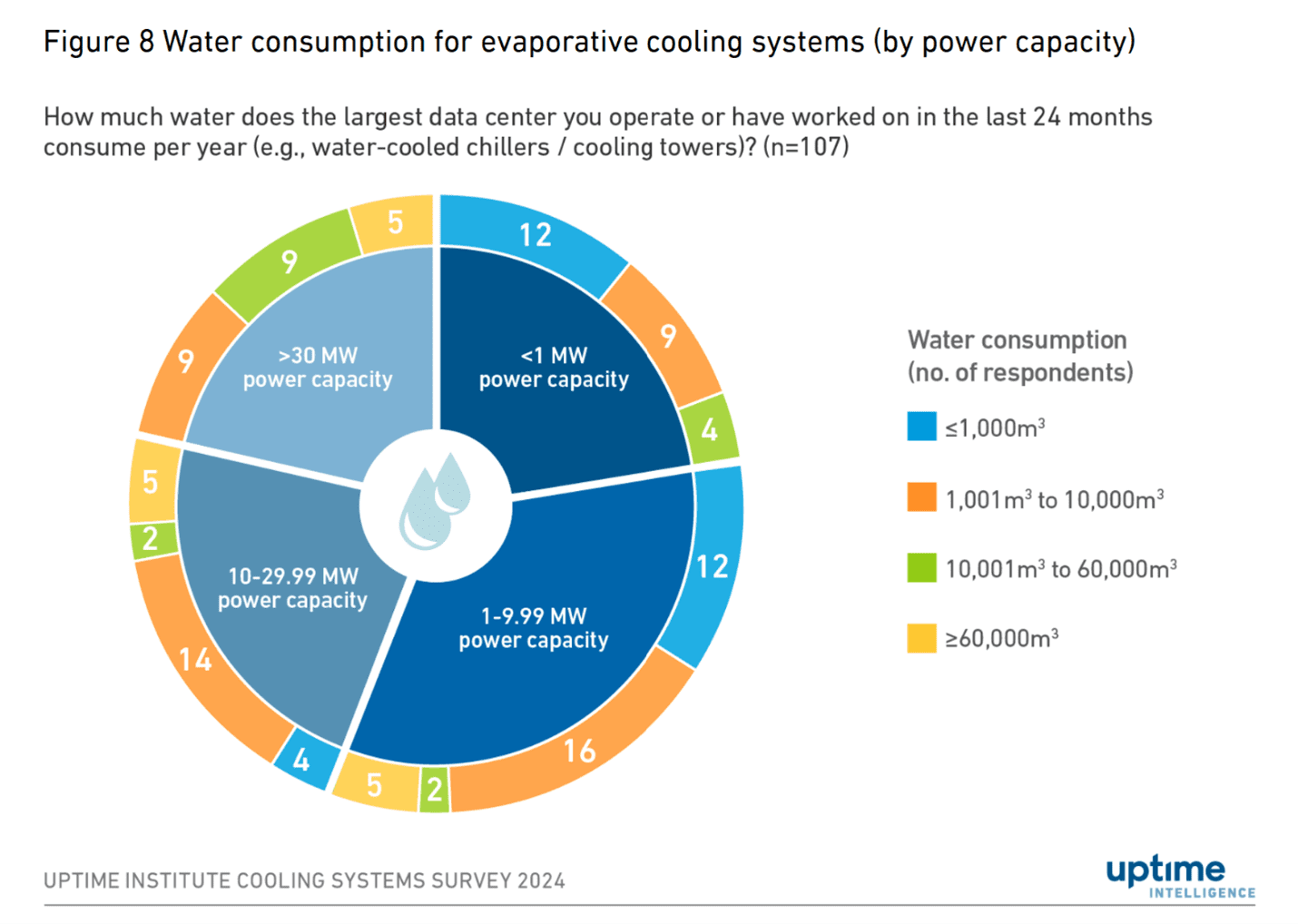
JetCool observes that this chart demonstrates how a well-designed and well-operated cooling system can minimize water usage, even in data centers with high energy demand. Notably, 40% of data centers over 30MW and 72% of those in the 10-29.99MW range achieve cooling with low annual water usage. Effective external heat transfer designs, such as adiabatic cooling, paired with the benefits of direct-to-chip (D2C) liquid cooling on the internal loop, can significantly reduce the need for evaporative cooling water.
Furthermore, data centers often draw water from regions already experiencing stress. In the U.S., 20 percent of the water used by data centers is sourced from water-stressed areas, impacting local communities and ecosystems. Locations like Texas, Nevada, and Arizona, chosen for their access to cheap, clean power, are expected to face increased water stress, which could influence site and cooling system selection for future data centers.
Rising Water Use in Technology: Insights from Uptime and J.P. Morgan and ERM Sustainability Institute
According to Financial Times, water consumption by data centers has surged in specific areas, including Northern Virginia, where data from Fairfax, Loudoun, Prince William, and Fauquier counties shows water usage rose from 1.13 billion gallons in 2019 to more than 1.85 billion gallons in 2023—a nearly two-thirds increase over just five years. This trend reflects a critical need for sustainable cooling practices to mitigate the industry’s water impact.
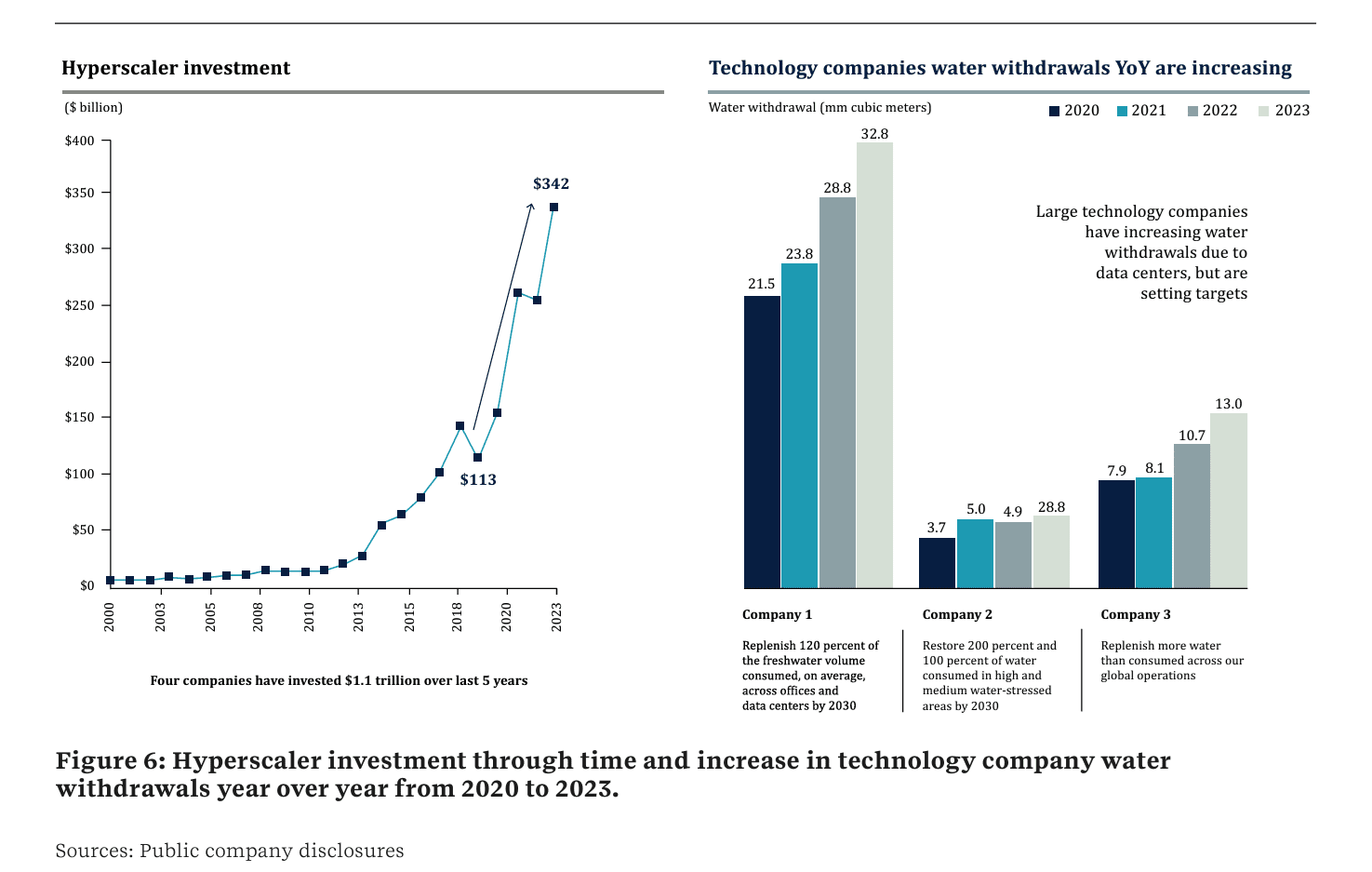
The chart emphasizes that while hyperscalers are rapidly scaling up their infrastructure investments, this expansion is accompanied by a marked increase in water consumption for cooling purposes. The data underscores the growing environmental impact and water use demands associated with data centers. To mitigate these impacts, leading technology companies have committed to sustainability targets aimed at replenishing or offsetting their water usage, especially in regions facing water scarcity.
Direct-to-Chip Cooling Options
In direct liquid cooling, two primary options exist: direct-to-chip water cooling or on-chip and immersion cooling with two-phase dielectric fluids. While two-phase dielectric cooling can be effective, it often relies on PFAS-based chemicals due to their resistance to heat and chemical degradation. However, these materials have been found to have significant environmental and health concerns, as they do not naturally break down and pose contamination risks in manufacturing and disposal. JetCool sidesteps these challenges entirely with its targeted single-phase direct-to-chip cooling technology, providing an efficient solution without the human and environmental impacts of PFAS-based chemicals.
How JetCool’s Approach Aligns with Current Needs
JetCool’s innovative cooling approach offers several critical advantages over traditional methods, directly responding to the challenges and insights highlighted in the J.P. Morgan and ERM Sustainability Institute and Uptime reports. Here’s how:
- Single-Phase Cooling for Minimal Water Use: Unlike conventional systems, JetCool’s technology relies on a closed-loop liquid cooling system, which circulates coolant directly across chip surfaces to absorb and transfer heat. The direct transfer of heat from the CPU to the water raises minimum operating temperatures and the temperature differential after heat capture, enabling significant water consumption reductions and efficiency improvements in the external heat transfer, aligning with both reports’ emphasis on sustainable practices and resource conservation. JetCool’s approach directly mitigates the operational and reputational risks associated with high water use, providing data centers with a reliable solution that supports long-term sustainability.
- Economizer-Ready Design and High Inlet Temperature Flexibility: Uptime notes in the report that economizer-equipped cooling systems can reduce PUE by taking advantage of external air conditions when feasible. JetCool’s system supports high inlet temperatures, up to 65°C, which enables facilities to operate efficiently without energy-intensive chillers or cooling towers. This feature allows data centers to adapt to local climate conditions, further enhancing sustainability. By minimizing energy use and cutting reliance on water, JetCool represents a practical and future-ready alternative. JetCool worked with a global conglomerate to showcase the power of its cooling over competing microchannel technologies, showing a switch to microjet cold plates saves 90% of water consumption, and significant power savings, compared to the incumbent.
- Enhanced Compatibility with Heat Reuse and Sustainability Goals: Both J.P. Morgan and ERM Sustainability Institute and Uptime highlight the potential of heat reuse as an alternative or augmentation to traditional cooling. JetCool’s direct-to-chip cooling technology is ideally suited to heat reuse systems, allowing data centers to capture and repurpose heat with minimal energy loss. This capability not only supports water resilience but also enhances facilities’ sustainability profiles by aligning with initiatives that prioritize energy conservation and environmental stewardship. To support local communities with heating bills could be an attractive meeting ground for large hyperscalers.
Balancing Cost, Energy, and Environmental Impact
One of the most pressing challenges in data center cooling is achieving a balance between cost, energy, and environmental impact. Uptime’s report underscores that recent advances have brought air-cooled and hybrid systems closer to water-based systems in terms of total cost of ownership (TCO). By integrating JetCool’s technology with these more efficient heat transfer systems, data centers can further optimize TCO while significantly reducing water consumption. JetCool’s system is designed for seamless retrofitting, meaning that operators can adopt the liquid cooling solution with minimal disruption and immediate benefits.
For regions with high energy costs or water scarcity, JetCool provides a scalable, cost-effective solution that aligns with evolving regulatory requirements. With the flexibility to be deployed in urban areas and remote locations alike, JetCool’s technology eliminates the need for extensive water infrastructure, reducing both upfront and ongoing expenses.
Immediate Impact and Scalable Sustainability
The water-energy nexus highlighted in Uptime’s report reinforces the importance of choosing a sustainable cooling system that accommodates both immediate and long-term goals. JetCool’s hybrid, self-contained liquid cooling system meets this need by delivering a solution that scales with a facility’s growth. This adaptability is especially valuable for high-density environments where traditional cooling solutions would require extensive, and often impractical, water resources. JetCool’s approach also supports high-powered GPUs and processors, working with chipmakers on processors two generations ahead of what’s currently on the market today, enabling data centers to maintain high-performance standards without environmental trade-offs.
For data centers transitioning from air-cooled systems, JetCool provides an accessible bridge to liquid cooling. By adopting JetCool, operators not only reduce water dependency but also enhance operational resilience, especially in areas facing water scarcity or regulatory restrictions on resource use.
Building a Resilient Future with JetCool’s Sustainable Cooling Technology
As J.P. Morgan and ERM Sustainability Institute and Uptime Institute’s findings suggest, the data center industry is in a period of accelerated evolution in cooling technology. The need for sustainable, efficient solutions has never been more pressing, especially as the industry faces growing scrutiny over resource consumption. JetCool’s direct-to-chip single-phase cooling technology offers a clear path forward, providing data centers with a cooling system that aligns with regulatory expectations, community interests, and environmental objectives.
By minimizing water in the cooling equation, JetCool positions data centers to meet both present and future demands without compromising performance. JetCool’s solution eliminates the operational risks and costs associated with high water use, empowering data centers to operate sustainably and efficiently across all climates. Together, we’re building a resilient future for data centers—redefining what’s possible in sustainable data center cooling and environmental responsibility.