


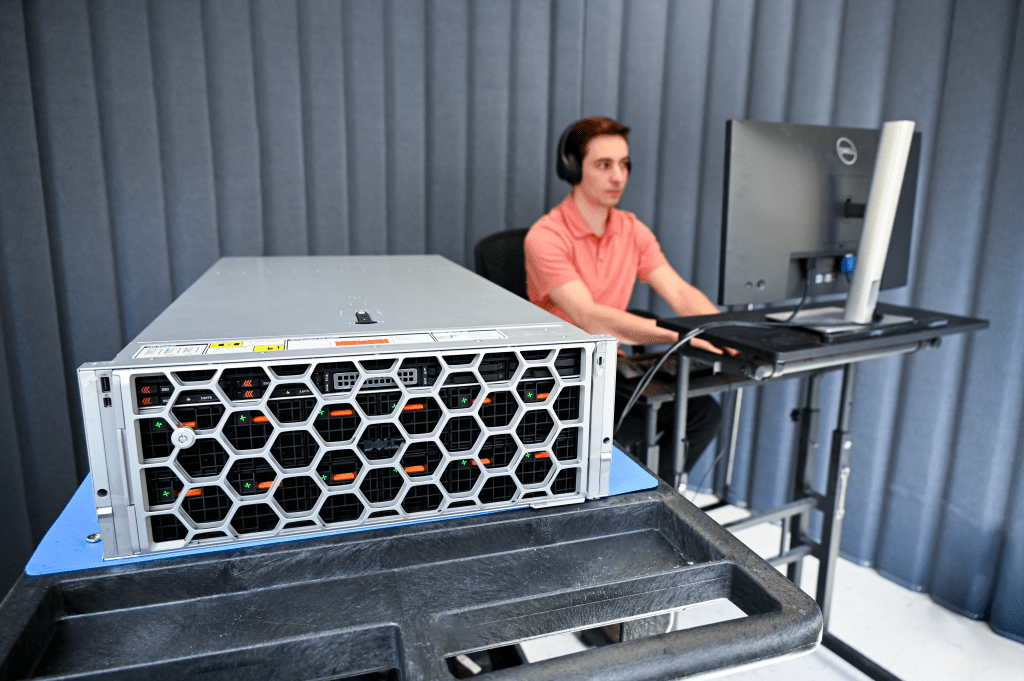
How JetCool’s liquid-cooled Dell XE7745 gives enterprises a lower-CAPEX path into high-density AI infrastructure
For many enterprises, AI infrastructure has started to feel like an all-or-nothing decision: invest in rack-scale systems, redesign the facility around extreme power density, and absorb the operational risk of a new cooling architecture, or delay deployment altogether.
That model does not fit every enterprise AI use case. Many organizations are not trying to build a hyperscale AI factory on day one. In fact, according to McKinsey & Company, nearly two-thirds of organizations have not yet begun scaling AI across the enterprise and remain in the experimentation or pilot stage. These organizations are deploying targeted workloads such as inference, fine-tuning, engineering simulation, GPU-accelerated visualization, and departmental AI clusters. They need serious compute density, but they also need a practical entry point.
That is where the liquid-cooled Dell XE7745 from JetCool creates a compelling path forward.
Instead of requiring a full rack-level purchase, JetCool’s solution enables high-density AI adoption at the server level, with cooling, rack-level infrastructure, commissioning, lifecycle services, and warranty support delivered through one accountable partner.
The AI Infrastructure Bottleneck is No Longer Just Compute


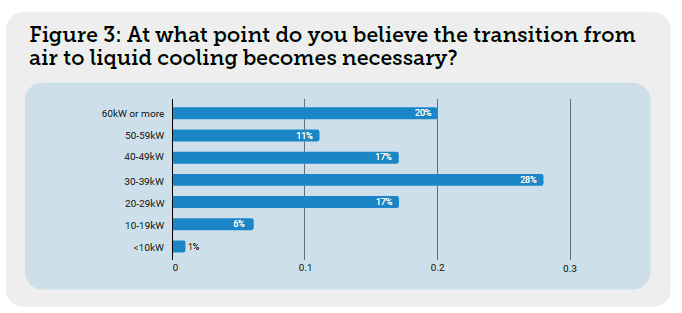
Density is the pressure point. In the survey, 28% of respondents identified 30–39kW per rack as the point where liquid cooling becomes necessary, while another 20% pointed to 60kW or more. For enterprise data centers, the challenge is no longer whether AI will require more dense infrastructure. It is how to add that density without forcing a full facility redesign or a rack-scale commitment before demand is proven.

Enterprise AI Adoption Is Becoming Modular by Design
For enterprises moving from AI exploration to real deployment, flexibility matters. Treating infrastructure as an all-in commitment can create unnecessary financial, operational, and facility pressure before workloads and utilization patterns are fully established. A modular deployment model gives organizations a more practical path forward: start with targeted capacity, validate real demand, contain capital exposure, and scale confidently as the business case becomes clear.
The DCD survey underscores that reality. Organizations want lower upfront capital cost, compatibility with existing IT and facility infrastructure, cooling efficiency, resilience, and long-term service models. They are also looking for proven technologies: 57% of respondents said single-phase cold plates are used in their facilities, far outpacing immersion and two-phase approaches.
A Practical Entry Point for Enterprise AI: The Liquid-Cooled Dell XE7745
JetCool’s liquid-cooled version of the XE7745 builds on that platform with SmartPlate direct-to-chip liquid cooling designed to remove heat directly from the silicon and manage sustained loads of up to 8kW per server. Testing shows that the solution can lower CPU temperatures by up to 7%, GPU temperatures by up to 11%, and total server power consumption by up to 30%. It also can reduce fan speed by up to 70%, fan power usage by up to 50%, and acoustic output by up to 23 dB.
That matters because enterprises are not only buying GPUs. They are buying usable, supportable AI capacity inside real facilities with real power, cooling, staffing, and budget constraints.


Lower CAPEX Starts with Incremental AI Deployment
Some OEM AI platforms and reference architectures are optimized around large rack-level deployments. That model can make sense for hyperscalers and organizations building AI factories at massive scale, but it is not always the right starting point for enterprise AI adoption. For many organizations, a rack-level commitment can create a significant CAPEX hurdle before workloads, utilization patterns, and internal demand are fully established.
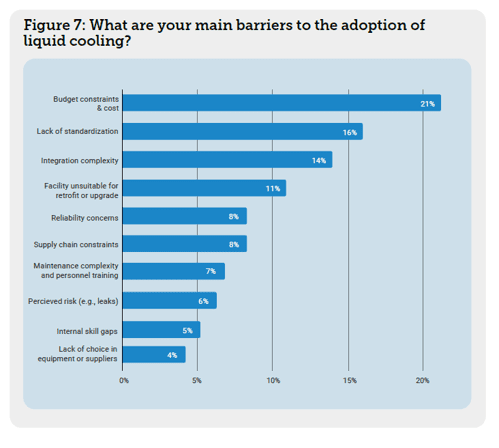
Current market dynamics make that flexibility even more important. As HPCwire has reported in its analysis of the agentic AI hardware market, GPU supply constraints, rising infrastructure costs, and long data center buildout timelines are making large upfront infrastructure commitments harder to plan with confidence. Those pressures are consistent with DCD survey findings, where respondents identified budget constraints and cost as the top barrier to liquid cooling adoption at 21%, followed by lack of standardization at 16%, integration complexity at 14%, and retrofit limitations at 11%.

Together, these trends point to a clear need for AI infrastructure models that reduce the initial barriers to entry while preserving the path to scale. Enterprises need the ability to start with targeted high-performance capacity, integrate liquid cooling into existing environments, and expand as AI demand grows.
The liquid-cooled XE7745 addresses these barriers with an incremental model: deploy one or a small number of high-density AI servers, validate workloads, prove utilization, and expand into additional nodes or racks as demand grows. JetCool’s server-level, turnkey model also reduces initial commitment and simplifies deployment.
Why Turnkey Solutions Matter for Liquid Cooling Deployment
The DCD survey showed that organizations are responding to these realities by prioritizing partners that can help manage the full deployment lifecycle. When asked what characteristics or partnership models were most important in a liquid cooling provider, respondents ranked end-to-end solution provider and facility and infrastructure integration support highest, both at 17%, followed by turnkey system provider at 14% and long-term support and lifecycle services at 12%.
The liquid-cooled XE7745 is delivered as a fully integrated solution that includes the server, SmartPlate direct-to-chip cooling, rack-level infrastructure, CDUs, manifolds, fluid distribution equipment, deployment support, commissioning, maintenance, and unified warranty coverage. Instead of forcing enterprises to coordinate across server vendors, cooling vendors, facility teams, service providers, and warranty boundaries, JetCool provides a single point of accountability.
Global Warranty and Support Are Critical to Reducing Deployment Risk
JetCool’s position as a Flex company is important here. Flex global manufacturing, supply chain reach, and service capabilities help enterprises standardize deployments across sites and regions, especially when AI infrastructure needs to scale beyond a single data center.
Unified warranty coverage across the server and cooling environment also removes a common source of operational friction. A thermal event, fluid distribution issue, component concern, or performance anomaly can create confusion when multiple suppliers are involved. A single, accountable support model helps reduce finger-pointing and accelerate resolution.
Enterprise AI Without the Leap to Rack-Scale
The liquid-cooled Dell PowerEdge XE7745 from JetCool is designed exactly for that. A high-density, server-level AI platform that combines direct-to-chip liquid cooling, integrated infrastructure, and global warranty and support in one streamlined model. For enterprises ready to operationalize AI, it delivers the compute their demanding workloads require, the modular deployment model real-world timelines demand, and the support needed to scale with confidence.
Discover more about JetCool’s liquid-cooled Dell XE7745 solution here: https://jetcool.com/dell/#dell-xe7745
Download the DCD>Cooling Survey here: https://www.datacenterdynamics.com/en/whitepapers/dcdsurvey-report-cooling/